
Practical learning experiences designed to strengthen professional judgement, improve problem-solving and help people make better decisions at work.
My corporate training programmes draw on experience across aviation, operations, safety, service delivery and leadership. They combine structured methods, real-world situations, facilitated discussions and practical exercises to help participants apply what they learn in their workplace.
Each programme can be adapted to the audience, organisational context and specific learning objectives.
Our Corporate Training Programmes
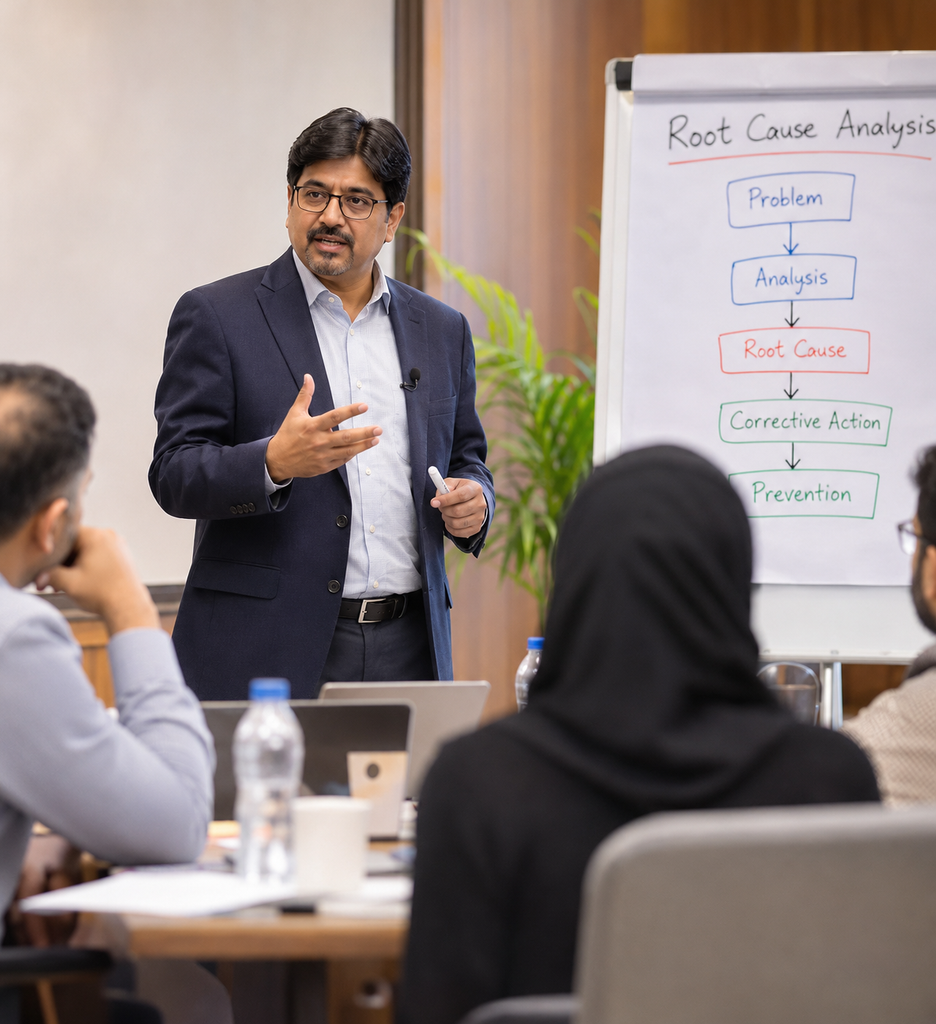
Root Cause Analysis (RCA) — Three-Day Practitioner Programme
A practical, three-day programme that equips participants with a structured, evidence-based approach to investigating operational, maintenance, safety, quality and reliability problems.
Participants learn to move beyond symptoms, examine direct and contributing causes, identify underlying systemic factors, and develop corrective and preventive actions. These corporate training programmes combine facilitated learning, practical tools, industrial case studies and group investigations.
Key learning areas:
- Problem definition
- Evidence gathering
- 5 Whys
- Fishbone Analysis
- Causal analysis
- Corrective actions and effectiveness verification
Data Storytelling for Strategic Influence — Executive Workshop
Designed for senior leaders and professionals who need to turn complex data into clear business narratives, influence stakeholders and support better decisions.
This one-day executive corporate training programme workshop moves beyond presentation techniques. It focuses on interpreting the significance of data, making important signals visible, developing a compelling business narrative and leading the leadership conversation towards a decision.
Four learning modules:
- Introduction & Context
- Story Design
- Story Development
- Making Presentations Impactful
The workshop combines executive challenges, practical redesign exercises, stakeholder simulations and a leadership presentation capstone.
Additional Reading & Resources
Explore these selected resources to deepen your understanding of data storytelling, effective visual communication and the art of translating analytical insights into meaningful business decisions.
These external resources complement the practical learning covered in this programme.
- Tableau – Data Storytelling: Using Visualization to Share the Human Impact of Numbers — Research-based whitepaper.
- United Nations – Practical Guide to Data Storytelling — A useful guide to context, narrative and visualisation.
- Tableau – 5 Best Practices for Telling Great Data Stories — Practical presentation techniques.
Leadership Alignment for Airlines and Airports — Three-Day Programme
A three-day programme designed to strengthen leadership alignment across airlines and airport operations. It focuses on building a shared organisational vision, improving cross-functional collaboration and equipping leaders to make coordinated decisions in a complex and rapidly changing aviation environment.
Participants explore how leadership alignment influences operational performance, service delivery, crisis response and organisational transformation. This corporate training programme combines aviation case studies, practical workshops, crisis simulations and collaborative action planning.
Key learning areas:
- Building a unified vision and aligning departmental goals
- Cross-functional collaboration and leadership communication
- Leadership decision-making during operational disruptions and crises
- Digital transformation and technology-enabled leadership
- Data-driven decision-making and digital integration
- Continuous improvement, feedback and accountability
- Sustainability and emerging aviation technologies
- Developing an organisational leadership alignment action plan
Format: Three days | Facilitated sessions, case studies, workshops and simulations
Designed for: Airline and airport leaders, senior managers, department heads and cross-functional leadership teams.
Ownership, Accountability & Leadership — Practical Workshop
Why do projects fail even when everyone has been assigned a responsibility? Why do teams sometimes complete tasks but fail to take ownership of the outcome?
This workshop explores the difference between responsibility, accountability and ownership, and examines how these behaviours influence individual performance, teamwork and organisational culture.
Participants explore practical workplace situations to understand how leaders can build a culture where people go beyond completing assigned tasks and take responsibility for outcomes.
Key learning areas:
- Understanding responsibility, accountability and ownership
- Moving from task completion to outcome ownership
- Building personal accountability and initiative
- Strengthening ownership across teams
- Leading by example and creating a culture of accountability
Format: Practical workshop with real-world stories, group discussions and workplace scenarios
Designed for: Leaders, managers, team leaders and professionals seeking to strengthen accountability, initiative and ownership within their teams.
Crisis Communication & Cyber Incident Management — Practical Programme
When an incident occurs, the quality and timing of communication can influence how effectively an organisation responds. Delayed messages, unclear ownership and fragmented coordination can compound an already difficult situation.
This practical programme helps participants understand how to communicate during operational crises and cyber incidents. It focuses on escalation, decision ownership, timely communication and the coordination of internal and external messages.
Participants are introduced to structured approaches such as the FACT–CARE–ACTION Model, the Golden Hour Principle and the Escalation Matrix. The programme also uses real-world case studies and scenario-based exercises to explore crisis coordination and response.
Key learning areas:
- Recognising incidents and understanding when to escalate
- Establishing communication priorities and decision ownership
- Applying structured approaches to crisis communication
- Coordinating internal and external messages
- Responding to cyber incidents, data leaks and communication pressure
- Learning through case studies and tabletop simulations
Format: Practical, scenario-based learning with case studies, guided exercises and facilitated discussion
Designed for: Leaders, managers, incident response teams, communication professionals and personnel responsible for operational continuity and crisis coordination.
Looking for a Programme Tailored to Your Organisation?
Every organisation has different challenges, priorities and learning needs.
My corporate training programmes can be adapted to your organisational context, audience profile and specific learning objectives.
Let’s discuss how a practical learning programme can support your organisation.
Email: hello@binaydimri.com