
Decision-making frameworks are useful only when they help leaders ask the right questions. Good decisions rarely come from applying a tool mechanically. They begin with a clear understanding of the situation, the ability to examine evidence and the willingness to recognise what may be missing.
Over the years, I have developed and used practical frameworks to help people examine evidence, understand complexity, identify risks and translate insight into meaningful action. Some draw on established problem-solving disciplines; others are original frameworks developed through my professional experience and writing.
These decision-making frameworks are intended to help leaders move beyond interpreting information at face value. They offer different ways to examine evidence, understand risk, recognise patterns and connect what the numbers reveal with the decisions that need to be made.
Original Decision-Making Frameworks
These frameworks bring together practical experience, structured thinking and the discipline of asking better questions. They are designed to help people move beyond surface-level information, recognise what matters and make their thinking more useful in real situations
| Framework | What it helps you do | The question it raises |
|---|---|---|
| D.I.R.E.C.T.™ | Interpret dashboard information and connect evidence to business impact. | What is the information really telling us? |
| S.T.O.R.Y.™ | Turn decoded information into a meaningful leadership narrative. | What does leadership need to understand and act upon? |
| A.L.T.I.T.U.D.E.™ | Apply aviation-informed thinking to leadership and decision-making. | What must we anticipate, understand and act upon? |
| C.O.C.K.P.I.T.™ | Keep context, connections and consequences visible when making decisions. | What might we be missing from our current perspective? |
| Second Question Principle™ | Examine the wider consequences of an apparently straightforward decision. | What else changes if we do this? |
D.I.R.E.C.T.™ — The Executive Interpretation Framework
D.I.R.E.C.T.™ provides a structured approach to interpreting dashboard information and turning it into meaningful leadership action. It moves through six questions: What changed? What pattern is emerging? What else is connected? What is the business impact? What story should leadership hear? What decision, investigation or action does the evidence justify now?
It helps leaders move beyond reading individual numbers to connecting evidence, understanding implications and triggering informed decisions.
S.T.O.R.Y.™ — The Executive Data Storytelling Framework
S.T.O.R.Y.™ is a framework for communicating decoded information in a way that supports leadership decisions. It moves from spotting the signal and tracing the pattern to observing the business impact, revealing the risk and identifying the leadership decision required.
It helps transform analysis into a meaningful executive story—one that connects evidence with consequences and leads towards a decision.
A.L.T.I.T.U.D.E.™ — Aviation Thinking for Leaders
A.L.T.I.T.U.D.E.™ brings aviation-informed thinking into leadership practice. It brings together eight disciplines: anticipating what may happen, listening to weak signals, thinking systemically, interpreting context, telling the story, understanding consequences, deciding early and executing decisively.
It is a leadership operating philosophy that encourages leaders to look ahead, understand the wider system and act with informed judgement, particularly when situations are complex or uncertain.
C.O.C.K.P.I.T.™ — Keeping Context and Consequence Visible
C.O.C.K.P.I.T.™ brings context, observation and consequence into the decision-making process. It guides leaders to observe what is happening, connect relevant information, understand the implications, prioritise what matters, influence decisions and take action.
It encourages a broader view of the situation, helping leaders keep the context and consequences visible rather than focusing only on individual indicators.
Second Question Principle™ — Looking Beyond the Immediate Decision
The Second Question Principle™ encourages decision-makers to look beyond the immediate problem and examine the wider consequences of a proposed action.
It begins with a simple but important question: “What else changes if we do this?”
A decision may appear logical when viewed in isolation. But its effects can extend beyond the original problem, influencing other operations, people, resources and outcomes. The principle encourages leaders to explore these connections before committing to a course of action.
The original question may not be wrong. It may simply be incomplete.
Weak Signal Index™ — Recognising What Others May Miss
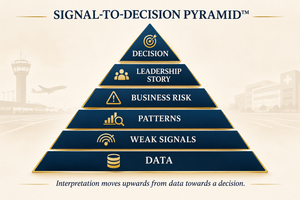
The Weak Signal Index™ is a conversation aid, not a prediction machine. It helps teams give deliberate attention to small anomalies and early indications that might otherwise be dismissed because they have not yet developed into visible problems or incidents.
By examining the evidence, considering why a signal matters and deciding what attention or action it deserves, the index helps organisations recognise emerging patterns and respond before concerns escalate.
Risk Narrative Canvas™ — Making Risk Visible
The Risk Narrative Canvas™ helps organisations move beyond recording what has happened to understanding what may happen next. It provides a structured way to connect the available evidence with the circumstances, possible consequences, people affected and decisions that need attention.
It encourages five essential questions: What happened? Why does it matter? Who is affected? What happens next? And what decision is needed?
The aim is to make risk discussions more meaningful by connecting evidence with consequence and future exposure.
KPI Story Map™ — Connecting Measures to Meaning
The KPI Story Map™ helps leaders connect a performance measure with the story it reveals and the decision it may require. Rather than treating KPIs as isolated numbers, it follows the connection between a KPI, the pattern it reveals, its business impact and the leadership decision that follows.
It encourages leaders to look beyond whether a measure is improving or declining and ask what the movement means for the organisation, what consequences may follow and what action deserves attention.
Executive Dashboard Canvas™ — Designing for Better Decisions
The Executive Dashboard Canvas™ provides a structured approach to executive reviews. It shifts the focus from presenting charts and reporting figures to asking the questions that matter for leadership.
It guides the discussion through six questions: What changed? Why? So what? What’s next? Who owns it? And what decision is needed?
The aim is to connect organisational priorities, performance, emerging risks and accountability with the decisions leaders must make.
Established Methods & Problem-Solving Tools
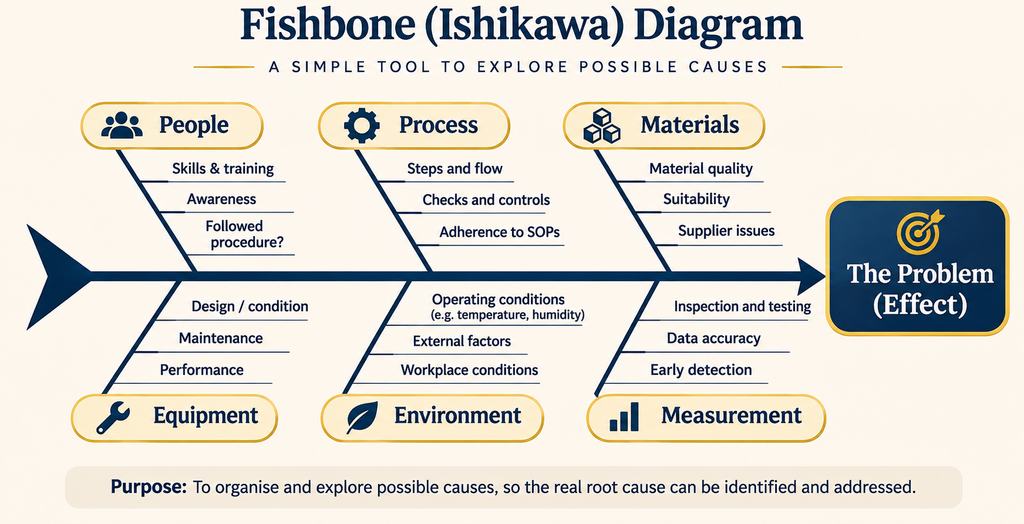
Alongside my original frameworks, I use established methods and disciplines to help organisations investigate problems, understand processes, assess risk and improve performance. These include Root Cause Analysis (RCA), the 5 Whys, Fishbone Analysis, Pareto Analysis, PDCA, DMAIC, Kaizen, FMEA and Fault Tree Analysis.
Putting Better Thinking into Practice
Frameworks and tools become valuable when they help us see a situation more clearly, ask better questions and make sound decisions. I explore their practical application through training programmes, workshops and learning experiences designed around real-world challenges.
Further Reading
Good frameworks develop through continued learning and practical application. The following resources offer additional perspectives on two important areas of organisational problem-solving and improvement.
- Root Cause Analysis: Explore approaches to identifying underlying causes, investigating problems and developing corrective action. Read the ASQ guide.
- Continuous Improvement: Learn more about the PDCA cycle and methods for improving products, services and organisational processes. Read the ASQ guide.
Putting Better Thinking into Practice
A framework becomes useful when it changes the way we examine a situation, the questions we ask and the decisions we make.
I explore these ideas through practical training programmes, workshops and facilitated learning sessions built around real workplace challenges.
Whether the requirement is better decision-making, stronger problem-solving, risk awareness or leadership development, the starting point is always the situation—not the tool.
Explore Training & Development
Discuss a training requirement